The Transformative Power of Watercolor Pattern Bouquets in Digital Design
The realm of digital creativity is constantly enriched by foundational assets that provide both structure and artistic flair. Among these, collections like the Watercolor Pattern Bouquets Elements stand out as comprehensive resources. These packages typically include a blend of complex arrangements, individual components like separate flowers and leaves, and a seamless repeating pattern. This multifaceted approach caters to a wide spectrum of design needs, enabling creators to quickly and easily assemble gorgeous and unique visual compositions.
A Detailed Look at the Core Components
Understanding the individual parts of such a collection reveals its versatility. The core offering usually breaks down into three distinct categories, each serving a specific purpose within a project workflow.
Arrangements: The Pre-Composed Foundation
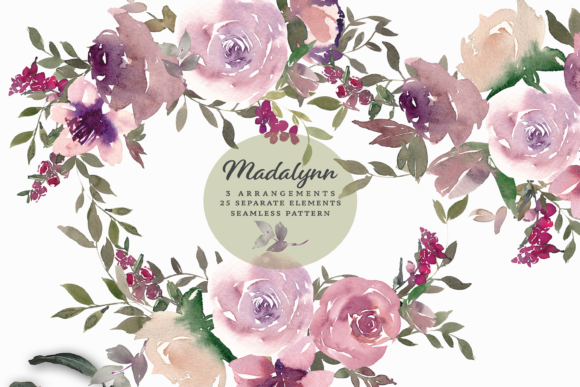
The larger bouquets, often sized around 17 by 10 inches at 300 dpi, are substantial artistic statements. These are not merely random clusters; they are thoughtfully composed arrangements that balance elements like focal flowers, supporting blooms, and filler leaves. They provide an immediate, high-impact visual solution. For a designer working under time constraints, these pre-made bouquets can serve as a beautiful centerpiece for an invitation, a website banner, or a poster background, requiring minimal additional manipulation.
Elements: The Building Blocks of Customization
Where the arrangements offer a quick start, the individual elements—often around 25 separate items including flowers and leaves at sizes like 6x4 or 4x4 inches—are the true engine of originality. These components empower the creator to deconstruct and rebuild. You can extract a perfect peony from one arrangement and pair it with a delicate leaf from another element kit, crafting a bouquet that precisely matches a client’s brand colors or a personal project’s theme. This granular control is key for bespoke design work, allowing for the assembly of layouts that feel personal and intentional rather than generic.
The Seamless Pattern: Infinite Application
The seamless pattern, typically a 12x12 inch tile, represents a different kind of utility. Created from the core dusty pink watercolor floral clipart motifs, this tileable image can repeat infinitely without visible seams. This transforms a finite set of assets into an endless backdrop. Its applications are vast: it can become the subtle texture on a packaging design, the full-width background of a blog, the interior of a shape in a presentation, or the fabric pattern in a product mockup. The seamless pattern extends the life and scope of the entire collection exponentially.
The Practical Advantages for Diverse Users
The utility of a well-structured asset pack like this is not confined to a single type of user. Its characteristics solve problems and enhance workflows for a broad audience across professional and hobbyist landscapes.
For the professional graphic designer or marketing agency, time is a direct cost. The ability to quickly access high-quality, transparent PNG files at 300 dpi in RGB format means projects move faster. A wedding stationery suite can be mocked up in hours using the arrangements, while a full brand refresh for a boutique might leverage the individual elements to create unique, cohesive assets across logos, social media, and print materials. The transparent background is a critical technical advantage, allowing easy integration over any color or photograph.
Educators and content creators find immense value in such resources. A teacher designing engaging classroom materials or online course presentations can use the floral clipart to add warmth and visual appeal without needing advanced illustration skills. A blogger or video creator can use the seamless pattern to produce consistent, aesthetically pleasing backgrounds for their content, elevating their visual branding with professional touches.
Small business owners, especially in sectors like crafts, lifestyle products, or event planning, can directly utilize these designs. They might use the elements to create their own product labels, promotional flyers, or social media posts, maintaining a high standard of visual appeal that resonates with their audience without outsourcing design work.
Hobbyists and DIY enthusiasts are perhaps the most liberated by these assets. With software ranging from advanced like Adobe Photoshop to freely available online tools, individuals can create personalized gifts—custom wall art, digital scrapbooks, event invitations, or fabric designs for home projects. The “quickly and easily” promise hinges on this accessibility; the assets are ready to be used, not just by experts, but by anyone with a creative idea.
Real-World Use Cases and Creative Implementation
Moving from abstract advantages to concrete examples helps illustrate the transformative potential. Consider a local florist looking to update their online presence. They could use a dusty pink watercolor floral arrangement as the hero image on their homepage, instantly conveying their aesthetic. The individual leaves and flowers could be used as icons for different service categories (bouquets, events, subscriptions). The seamless pattern could form a subtle border on their email newsletters. All elements maintain a consistent, soft, watercolor brand identity.
In publishing, an author commissioning a cover for a romance novel might work with a designer who uses these watercolor elements to build a custom, dreamy backdrop that feels specific to the book’s tone, far beyond a stock photo. The designer can manipulate the separate flowers, adjusting colors slightly or layering them with text to create a perfect, unique composition.
For event planning, a coordinator designing materials for a spring wedding could build an entire visual suite from one asset pack: the invitation using a large arrangement, the menu cards incorporating smaller elements, and the program booklet featuring the seamless pattern as a page border. This creates a unified, handcrafted feel that is both efficient to produce and deeply personal.
Key Considerations for Effective Utilization
To maximize the value of Watercolor Pattern Bouquets Elements, certain considerations are worth noting. While the PNG format with transparency is universally compatible, understanding resolution is crucial. The 300 dpi specification is ideal for print applications, ensuring crisp output on physical materials. For purely digital use, such as web graphics or screen presentations, the high resolution allows for scaling down without loss of quality, but designers should be mindful of file size for web optimization.
The RGB color mode is standard for digital and screen work, but it is important to remember that if a project requires precise color matching for commercial print (CMYK), some color shift might occur. Testing is advisable for critical color-based projects.
Furthermore, the real artistry often lies in combination. The most unique designs emerge not from using a single asset as-is, but from mixing and layering. A creator might overlay an arrangement on a textured background, blend the seamless pattern with a solid color gradient, or combine elements from this pack with other complimentary asset sets (like geometric shapes or line art) to create a truly hybrid style.
Ultimately, a resource like this serves as both a catalyst and a companion. It catalyzes projects by providing an immediate, beautiful starting point that bypasses the blank canvas paralysis. It companions the creative process by offering a flexible toolkit that supports the vision as it evolves from concept to finished product. Whether for professional efficiency, educational enhancement, business branding, or personal expression, these watercolor pattern bouquets and their constituent elements democratize high-quality design, enabling gorgeous outcomes across the spectrum of creative endeavor.